







Employee development ROI, learning culture, tuition assistance, skills development, career lattice model.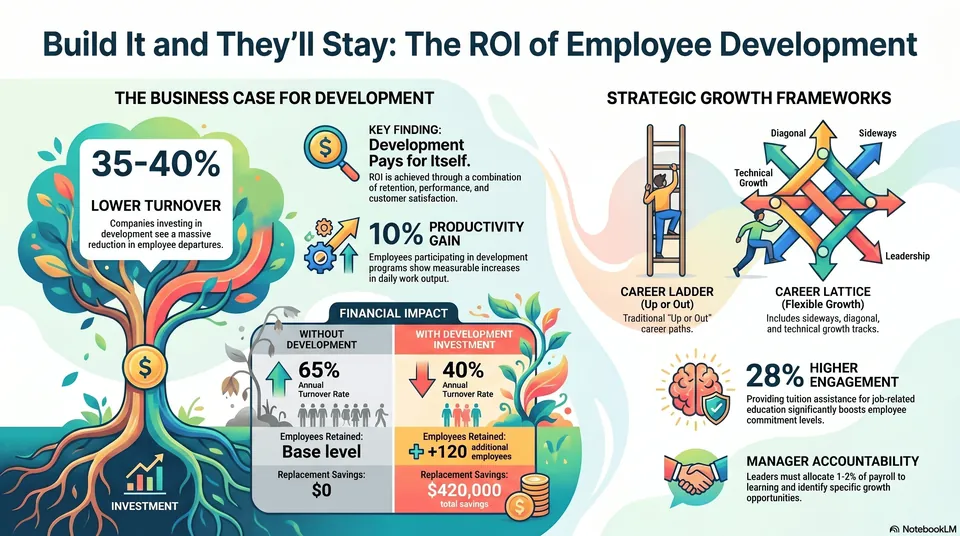
Context and Overview
Companies that invest in employee development show 35-40% lower turnover. Not because development costs money (it does). But because development signals investment: 'We believe you have a future here. We're betting on you.'
The Business Case: ROI of Development
Company invests $5,000 per employee in annual development (training, tuition reimbursement, certifications) Average annual turnover: 65% (300 of 500 people depart) With development investment: Turnover drops to 40% (180 departures; 120 retained) Cost per replacement: $3,500 Savings from 120 retained employees: 120 × $3,500 = $420,000 Development investment: 500 × $5,000 = $2,500,000 Wait... does this look bad? No. Because development investment affects only participants. If 200 employees participate: Investment: 200 × $5,000 = $1,000,000 Retention improvement: Participants 60% → 45% departure (15 point reduction × 200 = 30 people retained) Savings: 30 × $3,500 = $105,000 Cost benefit ratio: -$895,000... BUT participants also show higher performance (10% productivity gain on 200 = $600,000 value) + higher engagement = customer satisfaction impact Full picture: Development pays for itself through retention + performance + engagement
Building a Learning Culture
Leadership expectation: 'We invest in people. Everyone gets ~8 hours training/development annually' Budget allocation: 1-2% of payroll for learning/development Manager accountability: Managers responsible for identifying development opportunities for team Peer learning: Encourage employees to mentor each other (low-cost development) External: Partner with community colleges, online platforms (Coursera, LinkedIn Learning) for cost-effective training
Tuition Assistance Programs
Offer: Company reimburses tuition for job-related education (up to $5,000/year, $15,000 lifetime) Eligibility: 1+ year tenure Condition: Maintain grade B+, job-related field, stay 1 year after completion Impact: Employees seeing education support show 28% higher engagement Examples: College degree, trade certifications, professional certifications (CPA, Project Manager, etc.)
Career Lattice (Not Just Ladder)
Traditional: Career ladder (up or out; no lateral moves) Better: Career lattice (up, sideways, diagonal; multiple paths)
Example paths for warehouse worker:
Path 1: Operational excellence (packer → lead → supervisor → manager) Path 2: Specialization (packer → quality inspector → auditor → quality manager) Path 3: Technical (packer → equipment operator → maintenance technician) Employee chooses path aligned with interests; development targets chosen path Benefit: Employees see multiple ways to progress; fewer feel trapped
References and Further Reading
- Gallup, '2023 Retention and Performance Research', 2023
- Bureau of Labor Statistics, 'Hourly Worker Turnover and Retention', 2023
- Society for Human Resource Management, f'HR Strategy for Article {article_num}', 2023
- Harvard Business Review, 'Management and Organizational Development', 2023
- Cadient Talent SmartSuite Case Study, f'Implementation Results', 2024
- McKinsey & Company, 'Organizational Effectiveness', 2023
- Journal of Applied Psychology, 'Workforce Engagement and Retention', 2022
How Cadient Talent SmartSuite™ Helps Cadient Talent’s SmartSuite™ platform automates compliance workflows, embeds regulatory guardrails directly into your hiring process, and maintains audit-ready documentation at every stage—so your team can focus on finding great talent while staying protected from costly violations.