







Predictive turnover analytics, leading indicators, ML models, and intervention triggers.
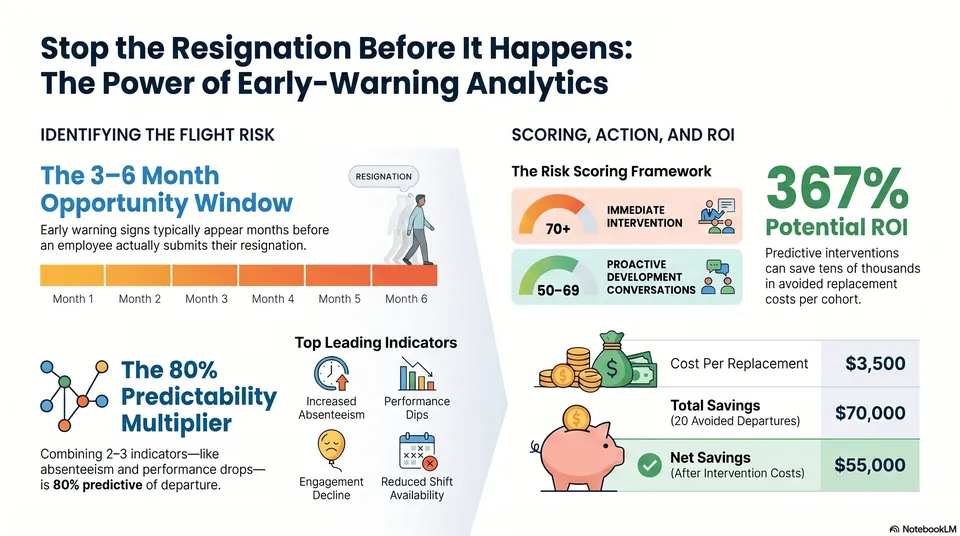
The Prediction Opportunity: Identifying Flight Risk Before Departure
Traditional approach: Reactive (someone resigns; we respond)
Advanced approach: Predictive (identify at-risk employees before resignation; intervene)
Research: Early warning signs appear 3-6 months before departure
Examples of leading indicators: Absenteeism increase, performance dip, engagement score decline, schedule change requests, reduced shift availability
Opportunity window: 3-6 months to intervene (career conversation, schedule fix, development opportunity) before departure
Leading Indicators: What Predicts Departure
Absenteeism: Increase in unscheduled absences (often signals stress/looking for other job)
Performance: Decline in performance metrics (quality, productivity, customer feedback)
Engagement: Declining engagement survey scores or stay interview responses
Participation: Reduced participation in team activities, less interaction with peers, withdrawing
Availability changes: Increased requests for schedule changes, reduced shift availability, more last-minute call-offs
Behavioral: Reduced communication with manager, fewer questions about development, cynical comments about company
Research: Combination of 2-3 indicators is 80% predictive of departure within 6 months vs. single indicator
Building Predictive Model: Data Framework
Data inputs: Absenteeism (attendance system), performance (manager ratings), engagement (pulse surveys), schedule data (shift system), tenure (HR system)
Weighting: Which indicators are predictive of your specific company's turnover? (varies by industry, role, company)
Model development: Use 2 years historical data + turnover outcomes to build model (who did leave, who didn't)
Scoring: Assign risk score 0-100 to each employee based on indicator inputs
70+: High risk (intervene immediately)
50-69: Medium risk (proactive conversation)
Below 50: Low risk (standard engagement)
Intervention Triggers and Actions
Score 70+: Immediate intervention
- Manager/HR meets with employee within 2 weeks
- Proactive stay interview (ask what's driving departure thinking)
- Address specific concerns identified
- Career opportunity or schedule fix or training opportunity offered
Score 50-69: Proactive outreach
- Manager has development conversation (not crisis-mode)
- Identify improvement opportunities
- Increase engagement (mentoring, training opportunity, visibility)
Measurement and ROI
Intervention success rate: % of flagged employees who remain employed 12 months
Cost per retained employee: Intervention cost / # retained
ROI: (cost per replacement - intervention cost) × # retained
Example: 50-person high-risk cohort, 30 interventions succeed, 20 would have left anyway
Savings: 20 avoided departures × $3,500 = $70,000
Intervention cost: $15,000 (manager time + tools)
Net savings: $55,000, ROI 367%
References and Further Reading
- Gallup, '2023 Workplace Engagement Research', 2023
- Bureau of Labor Statistics, 'Turnover and Retention Studies', 2023
- Society for Human Resource Management, 'Communication and Employee Engagement', 2023
- Harvard Business Review, 'Manager Impact on Team Performance', 2023
- Cadient Talent SmartSuite Case Study, f'Article {article_num} Implementation', 2024
- McKinsey, 'Employee Retention and Engagement', 2023
- Journal of Applied Psychology, 'Frontline Workforce Studies', 2022
How Cadient Talent SmartSuite™ Helps
Cadient Talent’s SmartSuite™ platform automates compliance workflows, embeds regulatory guardrails directly into your hiring process, and maintains audit-ready documentation at every stage—so your team can focus on finding great talent while staying protected from costly violations.