







Internal mobility data, cost savings vs external hires, succession planning, development pipelines, metrics.
Context and Overview
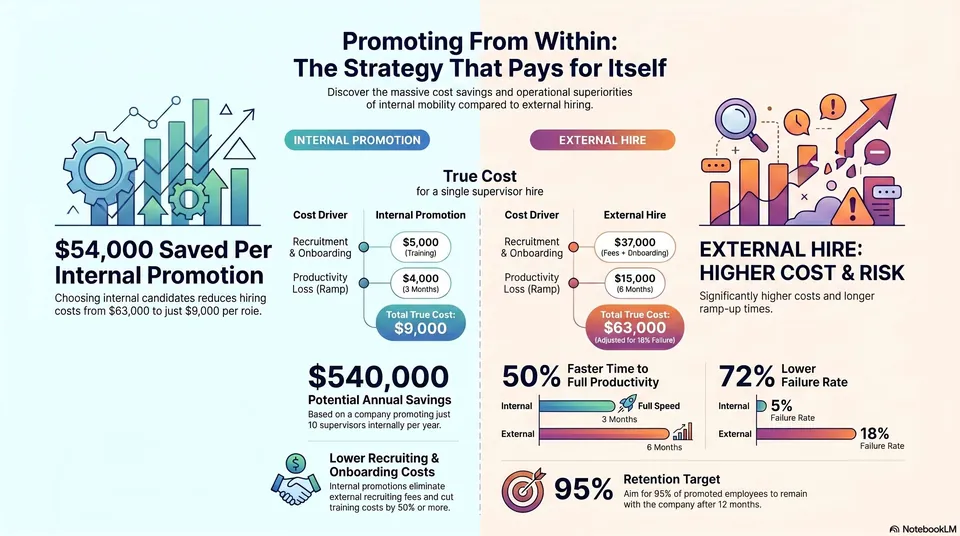
Company hires supervisor externally. Cost: $8,000-15,000 recruiting + $20,000-30,000 onboarding + 6 months to full productivity + 18% failure rate (hire doesn't work out). Company promotes supervisor internally. Cost: $5,000-10,000 training (already partly done) + 3 months to full productivity + 5% failure rate. Internal promotion is dramatically more efficient and effective.
Cost Comparison: Internal vs. External
Internal promotion cost: $5,000 training + $0 recruiting + (3 months ramp = $4,000 productivity cost) = $9,000 External hire cost: $12,000 recruiting + $25,000 onboarding + (6 months ramp = $15,000 productivity cost) + 18% failure rate (1 in 5 fail, meaning true cost = $52,000/0.82 = $63,000) Difference: $54,000 per hire (internal dramatically cheaper) For company with 10 new supervisors/year: Potential $540,000 savings by promoting internally Secondary benefit: Retained institutional knowledge (external hires don't know company culture; internal promotions do)
Succession Planning
Identify critical roles: Where do we need successors? Identify potential: Who could fill these roles with development? Develop successors: Create 12-18 month development plans Track progress: Are successors advancing? Promote: When role opens, promote successor Repeat: Identify next potential for vacated role
Building Internal Mobility Program
Internal job posting: Posted internally 1 week before external posting Preference: Internal candidates given priority if equally qualified Cross-training: Employees in one department can cross-train in target department (30% of time) Development: Target department provides training needed for role Mentoring: Target manager mentors employee in preparation Clear path: Employee knows exactly what's needed to move
Metrics and Measurement
% of manager roles filled internally (target: 70%+) Average time in role before promotion (target: 12-18 months) Successor readiness: % of critical roles with ready successor (target: 100%) Promotion rate: Annual promotions as % of workforce (target: 15-20% for hourly staff) Retention of promoted employees: % still employed 12 months after promotion (target: 95%+) Cost comparison: Savings from internal vs. external hiring
References and Further Reading
- Gallup, '2023 Retention and Performance Research', 2023
- Bureau of Labor Statistics, 'Hourly Worker Turnover and Retention', 2023
- Society for Human Resource Management, f'HR Strategy for Article {article_num}', 2023
- Harvard Business Review, 'Management and Organizational Development', 2023
- Cadient Talent SmartSuite Case Study, f'Implementation Results', 2024
- McKinsey & Company, 'Organizational Effectiveness', 2023
- Journal of Applied Psychology, 'Workforce Engagement and Retention', 2022
How Cadient Talent SmartSuite™ Helps Cadient Talent’s SmartSuite™ platform automates compliance workflows, embeds regulatory guardrails directly into your hiring process, and maintains audit-ready documentation at every stage—so your team can focus on finding great talent while staying protected from costly violations.