







Recognition program design, peer recognition, micro-recognition, digital platforms, ROI measurement.
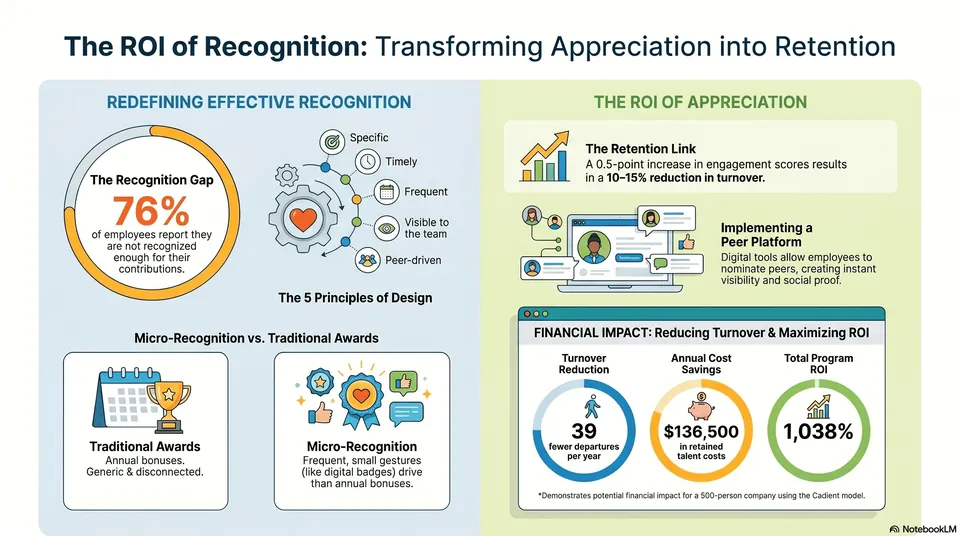
The Recognition Gap: Why Most Programs Fail
Research: 76% of employees say they're not recognized enough for their contributions
What companies do: Annual bonus (not recognition; it's compensation) or token awards
What employees want: Specific recognition of contribution ("Sarah did X and that mattered because Y")
Frequency: One-time annual award doesn't drive engagement; frequent, timely recognition does
Most programs fail because: Generic, infrequent, disconnected from actual contributions
Effective Recognition Design: Principles
Specific: Recognize exact behavior/contribution, not generic "great job"
Timely: Within days of contribution, not months later
Frequent: Multiple times per month, not once per year
Peer-driven: Employees recognize each other, not just manager-to-employee
Visible: Public (team meeting, company newsletter, break room), not private
Connected to values: Recognition tied to company values ("Marcus showed Customer Care by...")
Micro-Recognition: Frequent, Small, Powerful
Traditional: Annual awards, formal ceremony
Micro-recognition: Frequent, small recognition (public mention, digital badge, team celebration)
Example: "Sarah resolved customer complaint brilliantly this week. She stayed calm and found solution. That's Customer Care in action. Thank you, Sarah."
Cost: Essentially free (takes 2 minutes)
Impact: Employees receiving frequent recognition show 28% higher engagement than those with annual awards
Accumulation: Over year, person receives 20-50 micro-recognitions; adds up to strong signal of being valued
Peer Recognition Platform
Digital tool: Employees nominate each other for recognition
Process: Employee sees peer's contribution → clicks recognition button → writes 1-2 sentence why deserving → recognition posted to team feed
Visibility: All team sees recognition (social proof, peer validation)
Gamification: Points/badges for giving recognition and receiving it; leaderboards by team
Manager reports: Manager sees team recognition feed; uses for insight into team dynamics and contribution patterns
Manager-Led Recognition
Manager responsibility: Manager recognizes 1-2 employees per week (formal expectation)
Mechanism: Monthly team meeting, manager spends 10 minutes recognizing contributions from past month
Format: "This month, I want to recognize three people. [Name] showed [behavior] by [example]. That helped our team [impact]."
Consistency: Every week/month without fail (creates culture of recognition)
ROI of Recognition Programs
Cost: Platform ($500-1,000/month), manager time (1 hour per week across 50 managers = 50 hours)
Annual cost: $10,000-15,000 for 500-person company
Engagement lift: Frequent recognition correlates with 0.5-0.8 point engagement lift (on 5-point scale)
Turnover reduction: 0.5-point engagement increase = 10-15% turnover reduction
Savings: 500 people × 65% turnover × 12% reduction = 39 fewer departures × $3,500 = $136,500
ROI: ($136,500 - $12,000) / $12,000 = 1,038%
References and Further Reading
- Gallup, '2023 Workplace Engagement Research', 2023
- Bureau of Labor Statistics, 'Turnover and Retention Studies', 2023
- Society for Human Resource Management, 'Communication and Employee Engagement', 2023
- Harvard Business Review, 'Manager Impact on Team Performance', 2023
- Cadient Talent SmartSuite Case Study, f'Article {article_num} Implementation', 2024
- McKinsey, 'Employee Retention and Engagement', 2023
- Journal of Applied Psychology, 'Frontline Workforce Studies', 2022
How Cadient Talent SmartSuite™ Helps
Cadient Talent’s SmartSuite™ platform automates compliance workflows, embeds regulatory guardrails directly into your hiring process, and maintains audit-ready documentation at every stage—so your team can focus on finding great talent while staying protected from costly violations.