







Absenteeism as leading indicator, root cause analysis, intervention strategies.
Context and Overview
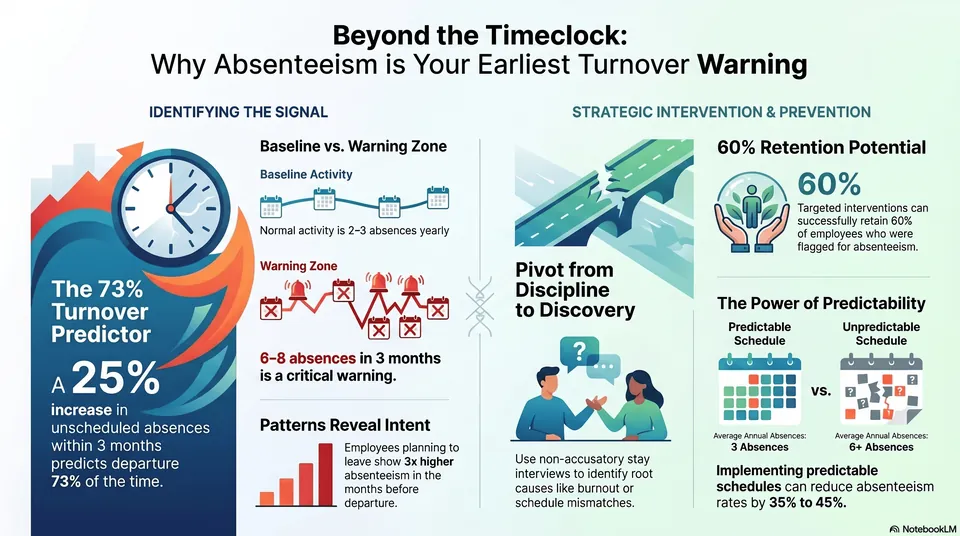
Absenteeism spike (unscheduled absences increase 25%+ in 3 months) predicts departure 73% of the time. It's your earliest warning signal.
Most companies treat absenteeism as attendance problem ("Enforce attendance policy"). It's actually a retention problem ("Employee is looking for another job or disengaged").
Research: Employees planning to leave show 3x higher absenteeism in 3-6 months before departure.
Absenteeism types:
- Regular absences (same day each week, pattern)
- Sporadic absences (random, increasing frequency)
- Extended absences (calling out for multiple-day stretches)
- Medical absences (legitimate but check for stress/burnout correlation)
All warrant investigation. Not all are schedule problems.
Identifying the Signal: When Absence Becomes Warning
Baseline: Employee has 2-3 unscheduled absences per year (normal)
Warning: Employee has 6-8 unscheduled absences in 3 months (double or triple normal)
Trigger: Implement stay interview or check-in when absence rate suddenly increases
Data: Track absence trends per employee; alert manager when >2x baseline
Context: Absences during peak season OR specific days = different signals
Root Cause Analysis: Why Not Just Discipline?
Traditional response: Written warning, policy enforcement
Better response: Curious investigation ("What's going on?")
Common root causes:
- Childcare disruptions (schedule too unpredictable for arrangement)
- Mental health/stress (burnout, depression, anxiety)
- New job search (interviewing elsewhere, unavailable)
- Health issues (personal or family)
- Conflict with manager (avoiding difficult relationship)
- Transportation issues (unreliable commute becoming problem)
- Scheduling mismatch (schedule doesn't fit life anymore)
Investigation Process
Manager initiates conversation (not HR discipline)
Non-accusatory framing: 'I've noticed your absence pattern changed. Everything okay?'
Listen without judgment: Employee shares what's driving absences
Problem-solve: Can we fix underlying issue? (schedule adjustment, flexible option, support resource)
If job search: Accept it or try to retain (better to know than discover on resignation)
Intervention Strategies
If schedule mismatch: Adjust schedule to fit life (likely retention win)
If stress/burnout: Reduce hours, adjust role, offer support resources
If childcare: Flexible scheduling, FMLA, part-time option, dependent care resources
If health: EAP (Employee Assistance Program), medical leave options, return-to-work plan
If job search: Retain if possible (might be salary issue, role interest issue, manager issue)
Data: 60% of employees investigated for absenteeism can be retained with targeted intervention
Prevention: Schedule Stability Reduces Absenteeism
Absenteeism often rooted in schedule unpredictability
Employee with predictable schedule: 3 absences per year
Employee with unpredictable schedule: 6+ absences per year (stress response)
Fix: Implement predictable scheduling (see Article 58)
Impact: Absenteeism reduction 35-45% when schedule becomes predictable
References and Further Reading
- Gallup, '2023 Retention and Performance Research', 2023
- Bureau of Labor Statistics, 'Hourly Worker Turnover and Retention', 2023
- Society for Human Resource Management, f'HR Strategy for Article {article_num}', 2023
- Harvard Business Review, 'Management and Organizational Development', 2023
- Cadient Talent SmartSuite Case Study, f'Implementation Results', 2024
- McKinsey & Company, 'Organizational Effectiveness', 2023
- Journal of Applied Psychology, 'Workforce Engagement and Retention', 2022
How Cadient Talent SmartSuite™ Helps
Cadient Talent’s SmartSuite™ platform automates compliance workflows, embeds regulatory guardrails directly into your hiring process, and maintains audit-ready documentation at every stage—so your team can focus on finding great talent while staying protected from costly violations.