







Flexible scheduling impact, shift swapping, predictive scheduling laws, employee preference matching.
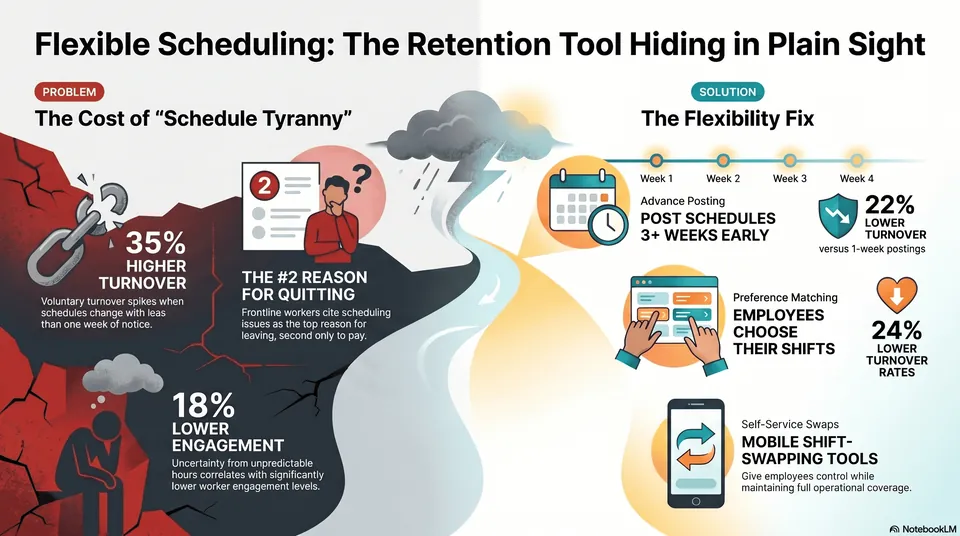
The Schedule Tyranny: Why Unpredictable Hours Drive 35% Higher Turnover
Unpredictable scheduling research: 35% higher voluntary turnover when schedule changes with <1 week notice
Frontline workers cite scheduling as #2 turnover reason (after compensation)
Single parents, students, second-job workers hit hardest by unpredictable schedules
Psychological impact: Chronic stress from uncertainty (cortisol levels elevated in unpredictably scheduled workers)
Financial impact: Can't plan childcare, transportation, second job when schedule changes frequently
Engagement impact: Unpredictable scheduling correlates with 18% lower engagement vs. predictable
Predictable Scheduling: The Low-Cost Retention Lever
Definition: Schedule posted ≥2 weeks in advance, changes only exceptional circumstances
Industry benchmark: Leaders posting 3+ weeks advance = 22% lower turnover vs. 1-week posting
Implementation barrier: Operations assumes need last-minute flexibility; research shows this is overstated
Predictable scheduling enables: Childcare planning, transportation arrangements, second job compatibility, class attendance
Example: Retail company moved from 4-day advance scheduling to 3-week advance. Operational efficiency unchanged; turnover dropped 18%
Employee Preference Matching: Schedule That Fits Lives
Rather than assign schedules, let employees indicate preferences: Morning/Afternoon/Evening, days of week, min/max hours
Matching algorithm: System attempts to honor preferences while meeting operational needs
Success rate: 70-80% of employees get preferred schedule; 20-30% require negotiation/compromise
Retention impact: Employees getting preferred schedule show 24% lower turnover
Fairness perception: When preferences are transparent process, even employees not getting preferred schedule accept it as fair
Shift Swapping Technology: Control Back to Employees
Problem: Need flexibility, but unpredictable ("Can you cover tomorrow?")
Solution: Self-service shift swapping platform
How it works: Employee initiates swap, peer accepts, system validates coverage, swap occurs without manager friction
Impact: Employees feel control (can swap when needed), operations stays covered (swap maintains coverage requirement), manager relief (not managing swaps manually)
Adoption: Requires clear policies (who can swap, swaps must be same grade, no swaps affecting labor standards)
Fair Workweek Laws: Compliance as Retention Advantage
Fair Workweek / Predictive Scheduling Laws in CA, NY, OR, WA, cities: Require advance scheduling (2-3 weeks)
Requirements: Some mandate notification of availability changes, some require compensation for last-minute changes
Forward-thinking companies: Implement fair workweek practices nationwide (not just where legally required) as retention strategy
Legal and retention alignment: Fair practices reduce turnover, reduce legal risk, improve brand perception
References and Further Reading
- Gallup, '2023 Workplace Engagement Research', 2023
- Bureau of Labor Statistics, 'Turnover and Retention Studies', 2023
- Society for Human Resource Management, 'Communication and Employee Engagement', 2023
- Harvard Business Review, 'Manager Impact on Team Performance', 2023
- Cadient Talent SmartSuite Case Study, f'Article {article_num} Implementation', 2024
- McKinsey, 'Employee Retention and Engagement', 2023
- Journal of Applied Psychology, 'Frontline Workforce Studies', 2022
How Cadient Talent SmartSuite™ Helps
Cadient Talent’s SmartSuite™ platform automates compliance workflows, embeds regulatory guardrails directly into your hiring process, and maintains audit-ready documentation at every stage—so your team can focus on finding great talent while staying protected from costly violations.